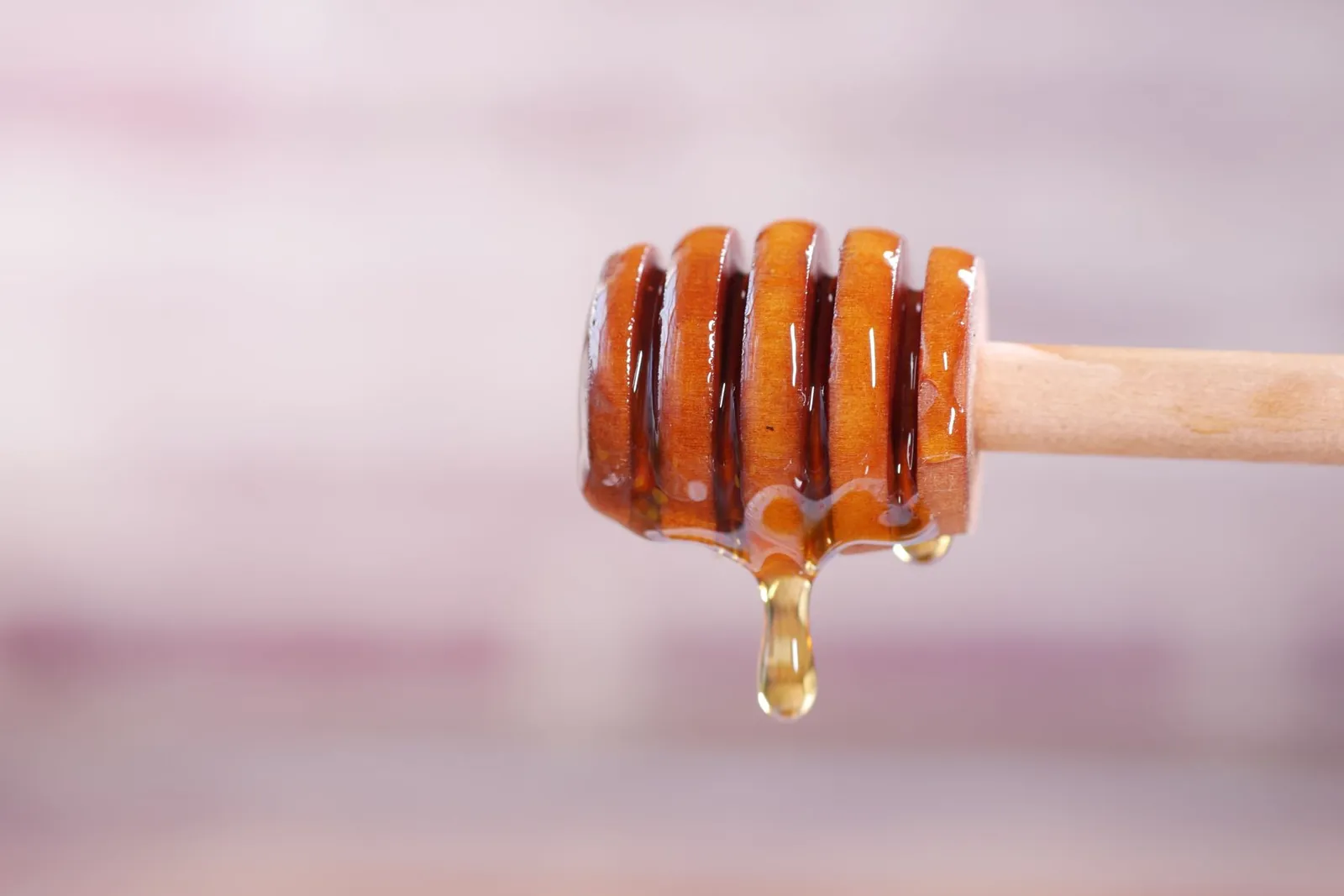
Most of us grow up thinking of honey as one thing — a sweet, golden goo in a squeezy bottle, more or less the same wherever it comes from. Then you taste two honeys side by side and the idea falls apart. A spoon of pale acacia is delicate and clean, almost like sugar syrup with a whisper of flowers behind it. A spoon of dark buckwheat, next to it, is a different animal altogether: malty, almost savoury, with the deep note of treacle or a strong ale. They are both honey, made by bees in the same patient way, and yet on the tongue they could be two separate ingredients. What decides all of that is the flower. Bees turn the nectar of whatever is blooming nearby into honey, and the plant they visit leaves its fingerprint on the colour, the smell and the flavour of the jar. Once you know that, the honey shelf stops being a wall of identical gold and starts to read like a small map of fields and orchards.
The flower makes the honey
Honey is, at heart, flower nectar that bees have concentrated and stored. Because nectar carries traces of the plant it came from, the source blossom shapes almost everything about the final honey. Bees foraging over orange groves make a light, citrus-scented honey; bees working a field of buckwheat make something dark and robust. A honey labelled with a single flower — acacia, orange blossom, lavender, chestnut — means the bees fed mainly on that bloom, and the jar leans on its character.
Most honey, though, is not from one flower. A jar simply marked "wildflower" or "multifloral" is a blend of whatever was blooming when the bees were foraging, which is why two jars of wildflower honey from different regions or seasons can taste noticeably different. That variety is a feature, not a fault: it is honey behaving like a farm product rather than a factory one.
Reading colour and aroma
You can guess a lot about a honey before you taste it. As a rough rule, the paler the honey, the milder and more delicate it tends to be; the darker it runs, the stronger, more mineral and more robust the flavour. Pale honeys — acacia, clover, orange blossom — are gentle and floral, good where you want sweetness without a strong stamp. Dark honeys — buckwheat, chestnut, heather, forest honeydew — are bold, sometimes almost bitter at the edge, and stand up to strong flavours.
Smell tells you the rest. Warm the jar slightly in your hands and take a sniff: you might catch flowers, caramel, hay, citrus peel or even something resinous and pine-like. That aroma is a preview of the flavour, and it is worth paying attention to before you decide where a honey belongs in your cooking.
Matching honey to the job
Once you can taste the differences, you can use them on purpose. A delicate acacia or orange blossom honey is ideal drizzled raw over yoghurt, fresh cheese or fruit, where its subtlety shines and nothing overpowers it. Stir a mild honey into tea or a dressing and it sweetens without shouting. These pale honeys are also the ones to reach for when you simply want clean sweetness and do not want a strong flavour taking over.
The bold, dark honeys earn their keep elsewhere. Buckwheat or chestnut honey holds its own against strong cheese, on dark toast, or brushed over roasted root vegetables and meats, where a delicate honey would vanish. Their deeper, malty edge also works beautifully in gingerbread, rich bakes and glazes. Think of pale honeys as seasoning for gentle things and dark honeys as seasoning for robust ones.
Raw, set and runny
Beyond flavour, honey comes in different textures, and that is mostly about crystallisation rather than quality. Runny honey has been kept liquid; set or creamed honey has crystallised into a soft, spreadable solid. Both are perfectly good — a set honey simply spreads more neatly on toast, while a runny one drizzles. Raw honey, which has not been heated much, keeps more of its aroma and often has a fuller flavour, so it is worth seeking out for tasting plain. If a runny honey ever turns grainy in the jar, it has not gone off; it has just crystallised, and a gentle warm-water bath brings it back.
Building a small honey shelf
You do not need a cupboard full of jars to enjoy the range. Two honeys cover most of what a kitchen asks for: one pale and delicate for drizzling and gentle sweetening, and one dark and robust for strong flavours and baking. Add a single-flower honey you love — whatever tastes of somewhere to you — and you have a shelf that can flatter almost anything. Taste as you go, keep a note of which honey suited which dish, and before long you will reach for a jar the same way you reach for the right salt or the right vinegar: by flavour, not just out of habit.